Ask someone to picture Hell and the image usually arrives already burning.
Fire. Furnaces. Red skies. Bodies surrounded by flame.
Dante Alighieri's Inferno contains plenty of heat, but the journey does not end there. The deepest region of Dante's Hell is a frozen lake.
At the bottom lies Cocytus, where traitors are trapped in ice. At its centre is Lucifer himself: enormous, winged and almost completely immobilized.
That inversion became the central idea behind the DOOMWRIGHT album INFERNO.
Not simply that Hell ends in ice, but that the entire descent moves gradually toward stillness.
The rule I set for the record was:
The deeper Dante descends, the less Hell moves.
The album begins with uncertainty and unstable movement. It passes through wind, rain, collision, fire, violence and fraud. Then, stage by stage, its fastest vocabulary disappears.
By the time Dante reaches Cocytus, the music is barely able to move at all.
That became the musical argument of the entire record.
Hell Does Not Simply Become More Violent
One of the fascinating things about Dante's Hell is that the punishments are not simply arranged as increasingly spectacular torture.
Each region has its own physical logic.
The lustful are carried endlessly by a violent storm.
The gluttonous lie beneath cold, filthy rain.
The avaricious and prodigal drive enormous weights against one another.
The wrathful fight on the surface of the Styx while the sullen remain trapped beneath it.
Heretics lie within burning tombs.
Violence becomes a river of boiling blood, a forest inhabited by those who destroyed themselves, and a desert beneath falling fire.
Fraud occupies the complicated trenches of Malebolge.
Then comes treachery.
And suddenly Hell freezes.
This change was the key to understanding how I wanted INFERNO to work as an album.
I did not want twelve songs that simply became heavier and more dramatic as Dante descended.
That would miss what interested me about the architecture of the poem.
Instead, I wanted the record itself to lose freedom.
Speed disappears.
Rhythms become simpler.
The register sinks.
Space closes.
Eventually even movement begins to feel difficult.
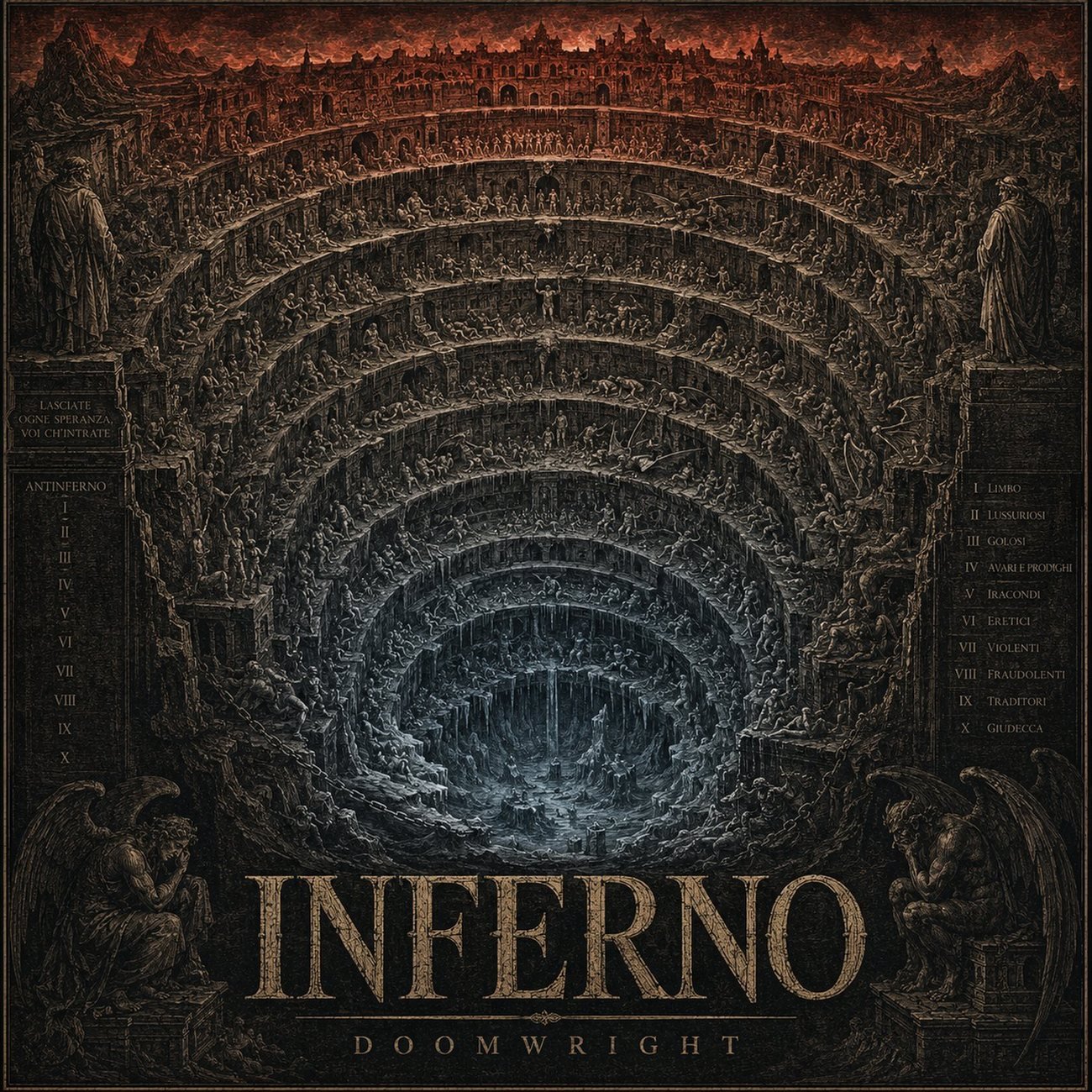
Contrapasso Becomes Musical Form
The relationship between a sin and its punishment in Dante's Hell is often discussed through the idea of contrapasso: punishment that reflects, exposes or reverses the nature of the act.
For the album, I wanted to push that principle beyond the lyrics.
If a punishment had a physical law, then the music should obey it.
The storm should not merely be mentioned.
The song should behave like a storm.
Fraud should not simply be described.
The composition itself should become difficult to trust.
Treachery should not merely happen beside a frozen lake.
The music should begin freezing.
That became one of the strictest rules of the project: punishment determines musical behavior.
It meant treating genre as a vocabulary rather than a fixed identity.
The foundation of INFERNO is funeral blackened death-doom, with liturgical dissonance, enormous low guitars, sparse percussion, organ, brass and severe strings. But faster death/thrash aggression is allowed to appear only at specific points where the story demands violent physical motion.
Then that vocabulary is taken away.
Before Cocytus, it disappears completely.
The listener should feel the album shedding its ability to move.
Before Hell: The Dark Wood
The descent begins before Dante even reaches the gate.
The first track is “The Dark Wood.”
Dante is lost.
That sounds simple, but it gave the opening track its entire purpose.
There should be no secure musical ground yet because Dante himself has none.
The track begins with unstable, almost directionless movement. The main descending motif is present only in fragments. It cannot fully state itself because the descent has not yet truly begun.
Even Virgil's arrival does not produce triumph.
He provides orientation.
Nothing more.
The musical world remains dark and unresolved.
Then comes the threshold.
Crossing the Gate
Track II, “Abandon All Hope,” is where Hell becomes irreversible.
I wanted the gate to feel ritualistic rather than cinematic.
Not an enormous Hollywood explosion.
A threshold.
Three immense low impacts separated by silence mark the crossing.
The music briefly erupts into faster movement, but that speed is not exhilarating. It represents compulsion: bodies driven forward because retreat is no longer possible.
Then the record falls back into weight.
That distinction became important throughout the album.
When INFERNO becomes fast, the speed should usually represent some form of physical or moral disorder.
Speed is not freedom.
Often it is exactly the opposite.
When Desire Becomes Weather
The fourth track, “The Infernal Storm,” takes its structure from the punishment of the lustful.
They are not simply standing somewhere while wind happens around them.
They have become part of the weather.
Their endless desire becomes endless motion.
So the track circles.
The rhythm refuses to settle completely.
Guitar patterns turn back upon themselves.
The music is constantly being pushed elsewhere.
And then Francesca appears.
This was one of the more interesting adaptation problems in the album.
I did not want her to sound obviously sinister.
She should sound persuasive.
Human.
Sorrowful.
Her explanation of love should retain its beauty.
The contradiction comes from everything surrounding her.
The words may make surrender to desire sound almost inevitable.
The storm never stops.
The music therefore becomes an argument with the character.
She does not need to sound false.
Hell answers her for us.
This is one of the reasons I find narrative metal interesting.
Music can allow two truths to occupy the same moment.
A character can sound convincing while the structure around that character tells us not to trust the conclusion.
Violence Has Three Different Bodies
Dante's circle of violence required something different.
Rather than treating violence as one continuous aggressive metal track, “The River of Blood” is structured as three environments.
Violence against others becomes the most physically aggressive section.
Violence against the self moves into the suicide forest, where the speed disappears and the sound becomes brittle and rooted.
Then the burning desert creates a third physical world.
The change matters because the three forms of violence should not feel interchangeable.
The album uses aggression where aggression actually belongs—and removes it when the punishment changes.
That principle becomes even more important when the journey reaches fraud.
Fraud Makes the Song Lie
“Malebolge” was one of the places where the concept of contrapasso as composition could be pushed furthest.
Fraud depends on the difference between appearance and intention.
Something presents itself as one thing while concealing another purpose.
So the song itself becomes unreliable.
It uses false endings.
Transitions imply one destination and arrive somewhere else.
Musical ideas return in the wrong register.
Familiar material appears in unfamiliar places.
The form begins to deceive the listener.
The objective is not technical complexity for its own sake. I did not want Malebolge to become a demonstration of musicianship.
It needed to feel untrustworthy.
By this stage of the album, the listener has learned some of its rules.
Now the record begins breaking them.
That is the punishment becoming composition.
And Then Hell Stops
Track X is “The Frozen Lake.”
This is where the record loses almost everything that previously created momentum.
The faster extreme-metal vocabulary is gone.
Percussion becomes extremely sparse.
Large gaps appear between events.
The music avoids the kind of crescendo that normally tells a listener something enormous is about to happen.
Nothing is coming to rescue the track from its own stillness.
That is the point.
Cocytus is not intended to feel like a beautiful frozen landscape.
It is enclosure.
Faces exist inside the ice.
Movement has been reduced almost to nothing.
For the album, betrayal suggested an equally severe musical idea.
Human society depends upon bonds: family, community, hospitality, loyalty and trust.
Treachery destroys those bonds.
So at the bottom of INFERNO, broken connection becomes immobility.
Everything that could move freely has gradually been taken away.
The deepest Hell is not the loudest.
It is the place where motion fails.
Hear the descent as you read.
Lucifer Has No Voice
Then Dante reaches Lucifer.
Extreme metal has produced countless magnificent versions of Satan.
The triumphant rebel.
The charismatic adversary.
The ruler on a throne.
The final enemy.
I wanted none of that.
The Lucifer at the centre of INFERNO is colossal, but his scale does not make him free.
His wings beat continuously.
Their wind freezes Cocytus.
The harder they move, the more completely the environment around him remains frozen.
The motion that should liberate him perpetuates his imprisonment.
That gave the eleventh track its most important rule:
Lucifer never speaks.
No commanding voice.
No monologue.
No grand Satanic chorus.
No heroic theme.
No “boss fight.”
“The Emperor of the Kingdom of Sorrow” represents him almost entirely through physical sound: enormous sustained tones, ice, slow wing-like impacts, silence and three isolated blows.
The project sheet reduced the concept to something I still think captures the track best:
a colossal mute machine whose wings freeze him in place.
That is more disturbing to me than another triumphant Devil.
He is enormously powerful and completely powerless.
His own action maintains his prison.
There is no final battle because there is nothing for Dante to defeat.
Lucifer has already done that to himself.
The Music Turns Upside Down
Dante and Virgil escape in one of the strangest moments of the journey.
They do not defeat Lucifer.
They climb through him.
And once they pass the centre of the world, their physical orientation reverses.
Down becomes up.
For the album, this meant that the musical logic established across eleven tracks could finally begin reversing as well.
The descent motif that repeatedly moved downward throughout the record begins to turn.
Weight starts falling away.
Distortion gradually recedes.
The music does not suddenly become joyful.
It simply begins to regain space.
And one particular sound has been deliberately withheld almost from the beginning.
Why the Stars Need Eleven Tracks of Darkness
Four recurring musical ideas run through INFERNO.
A descending chromatic figure marks the journey downward.
A restrained two-note figure represents Virgil's ability to restore direction.
Three enormous impacts appear at irreversible thresholds.
And then there is the Stars motif.
It is barely a motif at all.
Just an open interval.
But that open sound is denied to the listener throughout almost the entire album.
It does not belong in Hell.
Only on the final track—“To See the Stars Again”—does it finally appear.
The ending deliberately avoids victory.
No choir arrives.
No triumphant fanfare explains what the listener should feel.
Dante has not reached Paradise.
He has only escaped Hell.
After eleven tracks of compression, descent, distortion and enclosure, the final revelation is much smaller:
there is sky again.
There is distance.
There is air.
There are stars.
The final open interval should feel enormous not because it is musically complicated, but because the album has spent so long refusing to allow it.
That became the final law of the record:
The stars matter because Hell denied the listener a sky.
Hear INFERNO
INFERNO is a twelve-track DOOMWRIGHT concept album after Dante Alighieri's Inferno, built as a descent from unstable motion into near-total stillness. Its musical architecture follows the punishments themselves: storm becomes weight, weight becomes collision, violence becomes fracture, fraud corrupts form, and finally everything freezes.
At the centre waits a Lucifer who never speaks.
And beyond him, after eleven tracks without open sky, the music finally begins to breathe again.
DOOMWRIGHT — INFERNO