Imagine being forced to smile for the rest of your life.
Not because you are happy.
Not because you are performing.
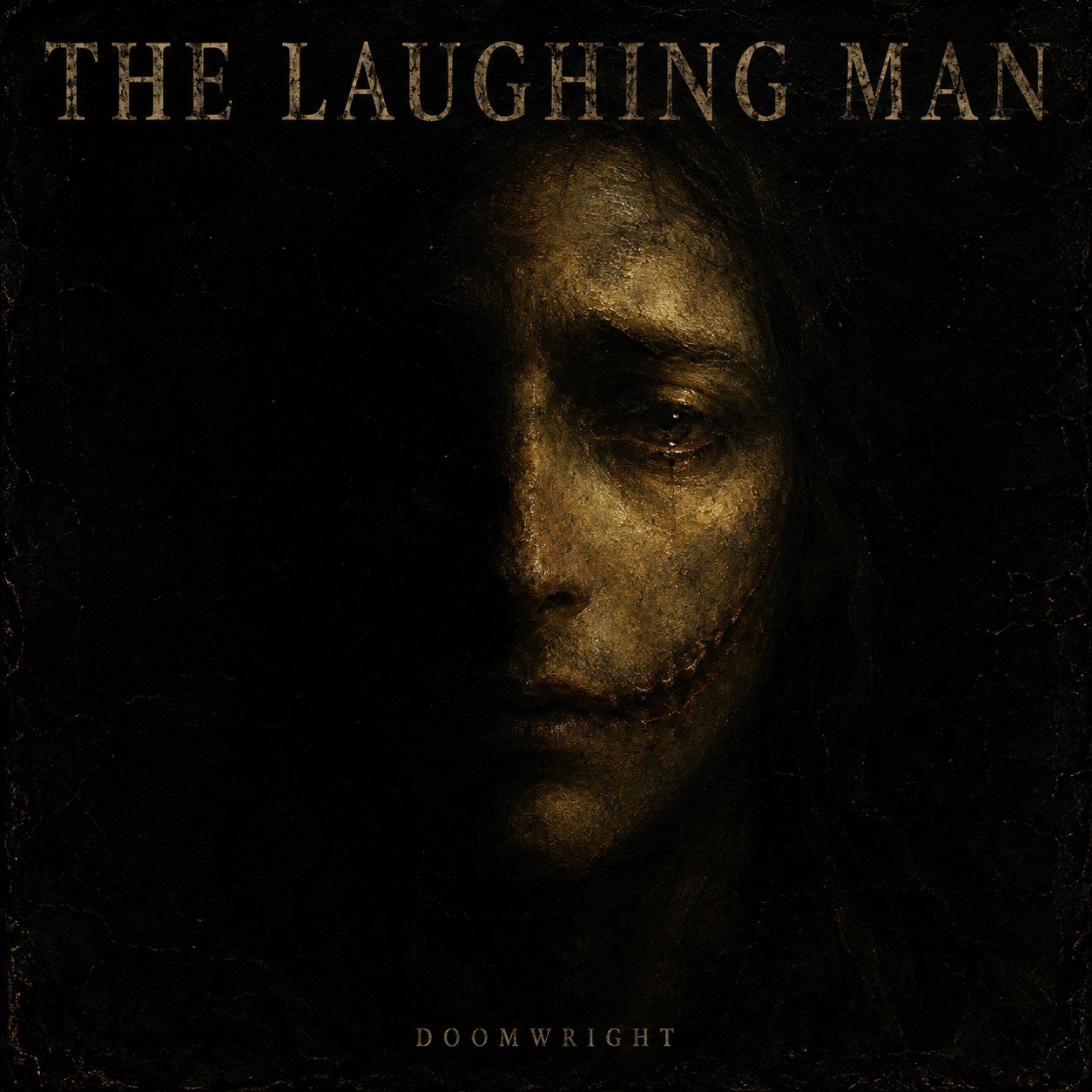
Because somebody altered your face when you were a child, and the expression can never be taken off.
Now imagine that this injury becomes the reason people want to look at you.
They pay to laugh.
They point.
They applaud.
They turn what was done to you into entertainment.
That is the tragedy at the centre of Victor Hugo's The Man Who Laughs — L'Homme qui rit — and the central idea behind the DOOMWRIGHT album THE LAUGHING MAN.
Gwynplaine's grin does not reveal what he feels.
It conceals it.
The expression imposed on him becomes stronger, socially, than the person underneath it. Almost everybody who sees him encounters the face first and the human being second.
Except Dea.
She is blind.
And because she cannot see the grin, she becomes the only person who consistently encounters Gwynplaine without the mask the world has placed over him.
That contradiction became the governing idea of the record:
The world sees the grin. Dea sees the man.
A Smile He Never Chose
The grin is not Gwynplaine's personality.
It is an injury.
That distinction matters because everything that follows depends on the world forgetting it.
Track II of THE LAUGHING MAN is called “Sutured Laughter.”
The song imagines the mutilation not as chaotic brutality, but as terrible craftsmanship.
Careful hands.
Quiet knives.
A face deliberately reconstructed so that a child will appear to laugh regardless of what he actually feels.
The album describes it as a lifetime's expression sewn into living skin:
The face a cage, the boy within.
From that moment onward, Gwynplaine can no longer control one of the most basic ways human beings communicate with each other.
Grief smiles.
Fear smiles.
Humiliation smiles.
Love smiles.
The exterior expression remains fixed while the person behind it continues changing.
Every mirror repeats the lie.
That is why I did not want the album to treat the grin simply as grotesque imagery.
The real horror is not how the face looks.
The horror is that the face speaks for him.
Forever.
Before the Face Comes the Abandonment
The record does not begin with the mutilation.
It begins with abandonment.
Track I is “Left for the Ice to Raise.”
A child is left on a frozen coast while the boat that brought him there disappears into darkness.
No prophecy.
No heroic origin.
No revelation that he is secretly important.
There is only winter.
Black water.
A retreating boat.
A gallows.
And a child whom somebody has decided is disposable.
The song gives the frozen landscape almost more authority than the people who abandon him:
The world showed him its true face first
And let the man's face go.
That opening matters because later the story will reveal another identity for Gwynplaine.
A title.
A bloodline.
A place in society.
But none of those things save him on the coast.
The respectable world is absent when he needs it.
The ice raises him first.
Two Heartbeats in the Whiteout
Gwynplaine then encounters someone even more helpless than himself.
A dead woman lies in the snow.
Beside her is an infant girl.
The child Gwynplaine takes the infant with him.
That infant is Dea.
In the album, this becomes “Two Heartbeats in the Whiteout.”
I wanted this moment to establish Gwynplaine before the crowd, before the stage, before aristocracy and before anybody tells him what social category he belongs to.
He is a child struggling to survive.
Yet he carries another abandoned child with him.
The song's central command is:
Carry what the world threw down.
That phrase becomes almost a hidden moral law of the album.
Society discards Gwynplaine.
Society discards Dea.
Later, Ursus takes both of them in.
The people who have been thrown away construct a family from what remains.
The Only Eyes That Never Lied
Dea is blind.
And that creates the central paradox of the entire story.
Everyone else can see Gwynplaine's face.
She cannot.
For everyone else, the grin arrives before Gwynplaine does.
It frames the encounter.
It tells them what to expect.
It invites laughter, curiosity, disgust or fascination before he has said a word.
For Dea, that visual information simply does not exist.
She knows him through voice.
Touch.
Warmth.
Weight.
Presence.
The beating heart beneath the scar.
That became Track IV:
“The Only Eyes That Never Lied.”
The title deliberately turns sight against itself.
The people with functioning eyes repeatedly misread Gwynplaine.
The woman who cannot see him does not.
The album expresses it directly:
The whole world laughing missed the man.
The blind girl gathered him.
This does not mean Dea possesses some magical ability to see a hidden soul.
It is more human than that.
She simply lacks access to the one piece of information that prejudices almost everybody else.
She cannot judge the grin.
So she must encounter the person.
The Only Real Home Has Wheels
Then there is Ursus.
Cynical.
Irritable.
Suspicious of almost everyone.
And considerably kinder than he wants anyone to notice.
Track V, “Gospel of the Rolling House,” is built around that contradiction.
Ursus complains about humanity while feeding abandoned children.
He insults the world while providing shelter from it.
He presents himself as bitter while behaving with compassion.
The record gives him one of its simplest character lines:
Curse loudly, and give quietly.
His home is a travelling wagon.
That detail becomes increasingly important later.
Gwynplaine will eventually enter wealthy rooms, aristocratic halls and a world that claims to restore his rightful position.
But the only place where he was genuinely known as himself was mobile, poor and temporary.
The album therefore states:
The only home in the story has wheels.
Everything grander will prove less secure.
Then the World Buys Tickets
Gwynplaine's face becomes entertainment.
The mutilation that trapped him also makes him commercially valuable.
People queue.
They pay.
They watch.
They laugh.
That transformation is the subject of Track VI:
“Applause Like Breaking Glass.”
I wanted applause to sound violent.
Because the original wound happened once.
The audience renews it every night.
They are not holding knives.
Their cruelty is cleaner.
They buy admission.
They enjoy themselves.
They go home.
And Gwynplaine returns the next night carrying the same face.
The song says:
They love him as a wound on stage.
That line became one of the most important in the record.
Because cruelty does not always appear as hatred.
Sometimes it appears as enthusiasm.
Sometimes the crowd loves what is happening.
That can be worse.
The Crowd Is the Grotesque Part
This also determined something important musically.
The obvious treatment of Gwynplaine would be carnival music.
Twisted fairground sounds.
Mad laughter.
A grotesque musical theme attached to his face.
I did not want that.
It would turn the album into another member of the audience.
Gwynplaine is not the joke.
The crowd is the problem.
So the harsher theatrical energy belongs to the social world consuming him.
The album is carried by two main vocal identities: a deep guttural growl associated with body, grief and physical human weight, and a blackened rasp associated with coldness and the cruelty surrounding him. No clean voice arrives to make the tragedy beautiful.
The goal was not to make the scar sound monstrous.
It was to make the world looking at it sound monstrous.
Hear the record.
The Beautiful Collect the Maimed
When Gwynplaine enters aristocratic society, the costumes change.
The appetite does not.
Track VII is “Ermine and Rot.”
Luxury surrounds him.
Perfume.
Lace.
Silk.
Privilege.
A noblewoman becomes fascinated by him.
But the same question remains:
Does she want Gwynplaine?
Or does she want the possession of something extraordinary?
The album answers with one of its coldest lines:
The beautiful collect the maimed.
At the fairground, Gwynplaine is public spectacle.
In the palace, he becomes private curiosity.
The social class has changed.
The objectification has not.
That is why the record treats wealth and decay together.
Ermine and rot.
The crown may be clean.
The root is not.
Crowned in the Wrong Mirror
Then Gwynplaine's social identity changes again.
His birth is recognized.
The person who was treated as a grotesque attraction is suddenly told he belongs among the aristocracy.
The face has not changed.
The man has not changed.
Only the information surrounding him has changed.
Yesterday he was a curiosity.
Today he is a lord.
That became Track VIII:
“Crowned in the Wrong Mirror.”
The song asks:
Which one is the costume?
Which one is the skin?
They dress him in ermine.
They place him among people who would have stared at him outside the palace walls.
Now they bow.
The title restores status.
But it cannot restore childhood.
It cannot remove the grin.
And it cannot rebuild the small travelling world in which he was known without either ridicule or reverence.
The central image is:
The lord looks out, the freak looks back.
That mirror contains two public identities.
Neither completely belongs to Gwynplaine.
One was imposed by mutilation.
The other is imposed by bloodline.
Both come from outside him.
The Title Restores Everything Except the Man
That is why the aristocratic revelation cannot function as a conventional triumph.
Society appears to correct an injustice.
A lost identity has been restored.
But what exactly has been restored?
A legal name.
A title.
A position.
A place in a hierarchy.
The same society is still defining Gwynplaine through categories it chooses.
First:
the freak.
Then:
the lord.
The labels change.
The mechanism remains.
Only Dea never required either category.
She knew him without needing the grin or the title to explain him.
That is why regaining his official place in society can simultaneously mean losing the world in which he was most fully himself.
Where Her Voice Used to Live
Then Dea dies.
And something larger than a relationship disappears.
Track IX is:
“Where Her Voice Used to Live.”
Dea was the only person whose perception of Gwynplaine never began with the false expression carved into his face.
When she disappears, thousands of eyes remain in the world.
But none of them see him in the same way.
The album turns that absence into physical space:
Where her voice used to live
There is a hole in every sound.
That is why the final movement cannot simply return Gwynplaine to an earlier life.
The earlier life is gone.
The stage still exists.
Society still exists.
His face still exists.
But the one person who made the face irrelevant does not.
The Sea Does Not Laugh
The final track is:
“The Sea Keeps What It Loves.”
The sea has been waiting since the beginning.
At the start of the record, a boat carries away the people who abandon Gwynplaine.
At the end, he moves toward the water himself.
That creates a circle.
The land has spent his life telling him what he is.
It carved him.
Sold him.
Laughed at him.
Desired him.
Named him.
Crowned him.
The sea does none of those things.
The song gives the water two simple qualities:
The water asks for nothing.
The water wears no mask.
The ending is not a victory.
And Gwynplaine's death should not be romanticized.
It is loss.
But inside the symbolic structure of the album, the water becomes the first environment that refuses to interpret his face.
There is no audience under the waves.
No applause.
No rank.
No mirror.
No crown.
Only silence.
A Face Made to Lie About Him Forever
That is what connects all ten movements of THE LAUGHING MAN.
Gwynplaine lives in a world where almost everyone decides what he is by looking at him.
The crowd sees comedy.
The aristocracy sees curiosity.
The duchess sees possession.
The state sees lineage.
The palace sees a lord.
None of those interpretations return control of his identity to him.
Dea is different because she never begins with the face.
She knows the person underneath it.
That is why the album's visual language repeatedly returns to eyes, mirrors, masks and reflections.
One image shows Dea holding Gwynplaine's face.
Another surrounds him with grinning spectators.
Another dresses him in ermine before a mirror that gives him back the old scarred identity.
The final plate abandons the human figure almost completely: a dark pier, a lantern and still black water.
The record begins with a face imposed upon a child.
It ends in a place where faces no longer matter.
And that leads to the line that ultimately became the album's clearest summary:
A face made to lie about him forever — and the sea the last honest thing left.
Hear THE LAUGHING MAN
THE LAUGHING MAN is a ten-movement DOOMWRIGHT blackened death-metal album inspired by Victor Hugo's 1869 novel The Man Who Laughs — L'Homme qui rit.
It follows Gwynplaine from abandonment and mutilation through his life with Dea and Ursus, his transformation into public spectacle, his encounter with aristocratic society, the restoration of his title and the loss of the one person who ever knew him without reading his face first.
The world makes his wound entertainment.
The palace makes it curiosity.
A title makes him a lord.
None of them give him back his face.
DOOMWRIGHT — THE LAUGHING MAN