A demon is easy to recognize in a supernatural story.
It enters.
It speaks.
It possesses somebody.
Fyodor Dostoevsky's Demons is more disturbing because the thing that takes possession does not need a body.
An idea enters a town.
It moves from one person to another.
It gives people a language for their frustrations.
It offers belonging.
It makes surrender feel like freedom.
Eventually it gives violence a reason.
And once the people have absorbed it deeply enough, the idea no longer needs to speak.
That became the central device behind the DOOMWRIGHT album THE POSSESSED:
The idea seduces. The people obey. Then the idea disappears, because the people have learned to continue without it.
The entire record is built around that transition.
At first there are individuals.
Then there is a room.
Then a group.
Then a murder.
Then one mouth.
Then a town moving toward destruction.
And finally one human voice returns beside black water.
The album master defines the record not as a battlefield or a haunted city, but as “a fever of minds” — cold, spiritually exhausted and driven by ideological possession rather than supernatural horror.
Dostoevsky's Demons Is Already a Story About Contagion
Demons was first published in 1871–72. It follows a fictional provincial Russian town increasingly destabilized by conspiracy, radical political ideas, manipulation and violence, with Pyotr Verkhovensky driving much of the organized chaos and Nikolai Stavrogin exerting a powerful, difficult-to-define influence over the people around him.
The novel also had a real historical provocation behind it. Dostoevsky began writing after the 1869 murder of Ivan Ivanov by members of Sergei Nechayev's revolutionary circle after Ivanov tried to break away. Contemporary reference works identify that murder as an important basis for the novel and associate Nechayev particularly with Pyotr Verkhovensky.
But THE POSSESSED is not a historical reenactment of the Nechayev affair.
And it is not an attempt to summarize every character and argument in Dostoevsky's novel.
I wanted to reduce the book to something more abstract:
What does possession sound like when the demon is an idea?
The Album Begins Before the Idea Speaks
Track I is “The Thaw.”
Nothing openly terrible has happened yet.
The town is still a town.
The bells still ring.
The houses remain standing.
People still possess their individual names.
But winter is breaking.
The river is opening.
Something is loosening.
That matters because the first track contains no clean voice of the Idea.
The Idea has not announced itself.
It is only atmosphere.
The lyrics describe a fever with no body moving quietly through the town:
Only a fever with no body
Passing from the young to old.
That is the beginning of possession.
Not a speech.
Not a manifesto.
Not an invasion.
A change in temperature.
A door left open.
A thought that seems to have appeared by itself.
The town calls the thaw spring.
It does not yet understand what is melting.
Then the Idea Gets a Voice
Track II is “No Author.”
This is where the defining device of the album begins.
For the first time, a deep clean baritone enters.
That voice does not represent a normal character.
It represents the Idea itself.
The master sheet makes this absolutely explicit: the baritone is deep, cold, seductive and preaching. It appears during the seduction of Tracks II–IV, gives its final command in Track V, and is never heard again.
Its first words are important:
I have no name to carve on churches
I have no father, no first breath.
The Idea claims to have no author.
That makes it harder to resist.
A person can be blamed.
A leader can be rejected.
A speaker can be exposed.
But an idea that feels as though it appeared inside your own mind is more difficult to identify as something external.
That is why the song says:
I am the thought you almost spoke aloud.
The listener should experience the baritone not as a dictator shouting orders, but as something dangerously reasonable.
Something attractive.
Something that seems to finish a sentence the characters were already thinking.
The Most Dangerous Possession Feels Like Your Own Thought
That is what interested me most.
The Idea does not say:
Obey me because I am powerful.
It says:
You already agree with me.
That distinction changes the nature of possession.
If an external tyrant forces people to act, responsibility remains easy to locate.
But if each person believes the thought originated inside themselves, the chain becomes harder to see.
Track II makes that explicit:
Each believed the thought his own one
Each believed his heart was free.
The record therefore treats ideological possession as a loss of authorship.
The possessed person still speaks.
Still moves.
Still explains.
Still believes they are choosing.
But the grammar of their thinking is no longer entirely theirs.
The Low Room Turns People into a Pronoun
Track III is “The Low Room.”
The conspiracy becomes physical.
People gather.
A door closes.
The room is warmer than the street.
The Idea offers relief from isolation.
That temptation is important.
The people are not simply told to become cruel.
They are told that surrender will make them less alone.
The baritone says:
There is a warmth in giving over
There is a freedom past the fear.
Then comes the real exchange:
Set your name upon the table.
Set the conscience your mother gave.
The master project contains a subtle structural arc running through the whole album:
the pronouns change.
The early record still contains separate people.
Track III begins producing we.
Track VI becomes a collective mouth.
Only at the very end does an individual I return.
That pronoun change may be one of the most important things in the album.
Possession is not just believing something.
It is losing the grammatical ability to stand outside the group.
“We” Can Be a Liberation — or a Warning
There is nothing inherently sinister about collective identity.
People need communities.
Belonging can save lives.
Shared purpose can create extraordinary things.
That is precisely why the language works.
The Low Room does not advertise itself as imprisonment.
It advertises escape from the burden of being alone.
But the bargain gradually becomes visible.
First:
I am no longer isolated.
Then:
I am part of us.
Then:
There is no meaningful I outside us.
And finally:
Anyone who tries to recover an individual name becomes a threat.
That final step leads directly to murder.
Stavrogin Is Not the Idea — He Is the Mirror
Track IV is simply called:
“The Mirror.”
This is the album's interpretation of Stavrogin.
I did not want to portray him as the straightforward leader of the possessed.
That would make him too simple.
In Dostoevsky's novel, Stavrogin exerts extraordinary fascination over the people around him, and other characters repeatedly attempt to place their own hopes, theories and ambitions onto him. Project Gutenberg's public-domain text even has Stavrogin remark on how people keep trying to make him “raise” their respective flags.
That became the key.
The track describes a man people mistake for depth because he reflects their own convictions back at them.
The baritone sings:
But there is nothing at the centre
No god to hate, no love to keep
A clean and perfect empty mirror
They mistook for something deep.
This is deliberately the album's most exposed clean-vocal moment.
The beautiful voice should sound magnetic.
Almost trustworthy.
But there is nothing warm behind it.
The horror is charisma without conviction.
Other people supply the belief.
The mirror supplies the shape.
An Empty Centre Can Still Gather a Crowd
This is one of the darkest ideas in the adaptation.
People often assume that a dangerous movement must have a strong belief at its centre.
But what if the centre is empty?
What if different followers see different things in the same figure?
One sees rebellion.
Another purity.
Another power.
Another permission.
Another destruction.
The empty figure can accommodate all of them precisely because he commits fully to none.
That is why “The Mirror” contains the line:
I can be anything you long for
And so I am not anything at all.
The more people project into the centre, the more powerful the emptiness appears.
Then Someone Remembers His Name
Track V is “Blood on the Ice.”
This is the hinge of the entire album.
Someone wants out.
The language is simple:
He has remembered his own name.
That single act is treated as dangerous.
Because once a collective depends on the suppression of individual conscience, remembering one's own name becomes rebellion.
Dostoevsky's novel contains the murder of Shatov, who has separated himself from the conspiratorial group and whose position makes him dangerous to Verkhovensky and the circle. The book explicitly presents the problem of whether someone can leave and depicts threats surrounding Shatov once he has broken with them.
The DOOMWRIGHT track turns that episode into the album's decisive transformation.
The Idea speaks one final time:
Take him to the black place past the birches.
Then the clean voice disappears.
Forever.
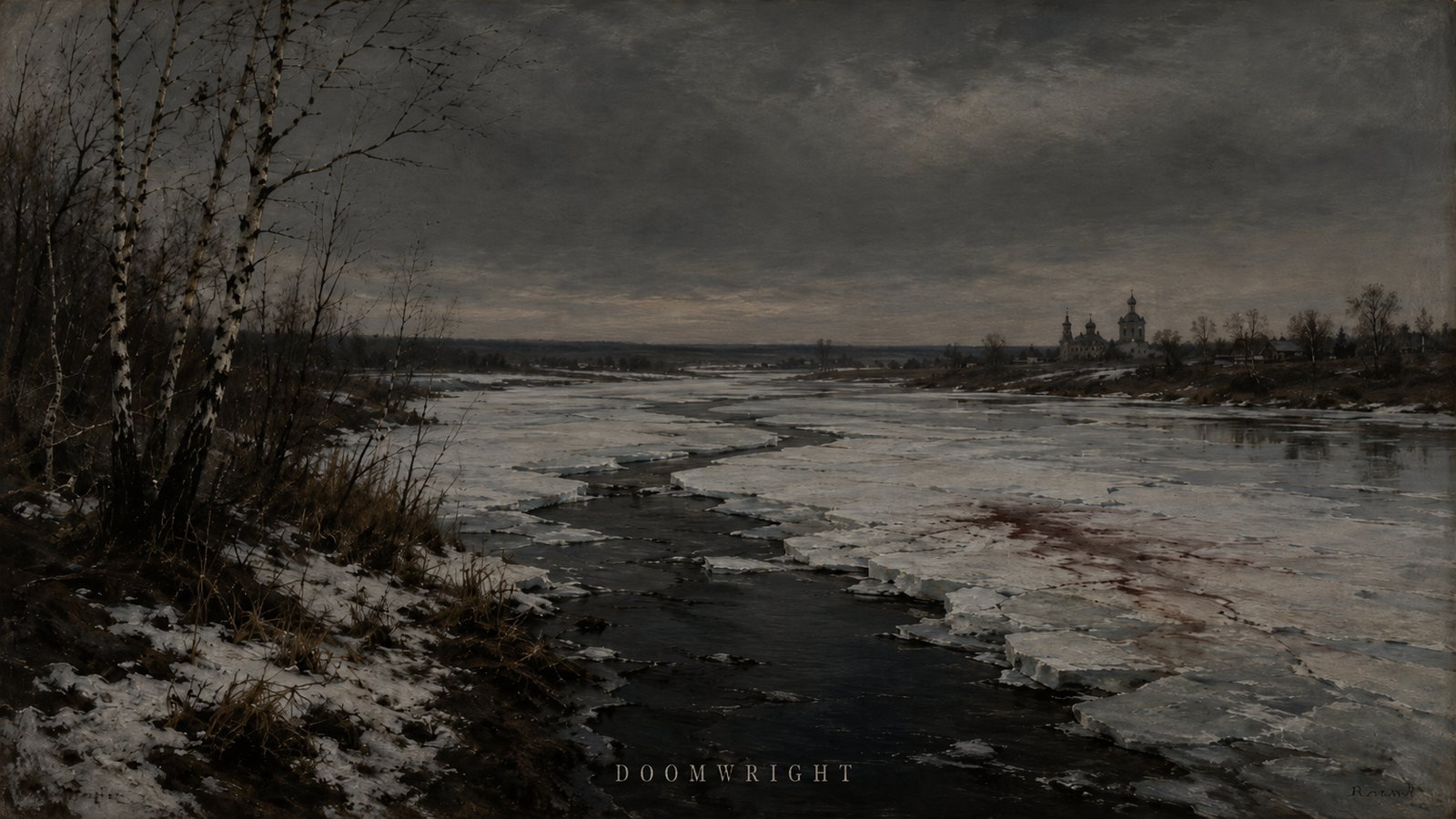
The Idea Stops Speaking After the Murder
This is the most important production decision on THE POSSESSED.
Before the murder, the Idea needs to persuade.
After the murder, persuasion is unnecessary.
The people have crossed the threshold.
Tracks II, III and IV contain the seductive clean baritone.
Track V begins with its final command.
Tracks VI, VII and VIII contain no clean Idea voice at all.
The listener may not consciously notice the first time.
But they should feel that something has changed.
And the reason is horrible:
the possessed no longer require the possessor.
They know what to do.
The ideology has become behaviour.
Hear the fever.
Murder Does Not Unite Them — It Removes the Exit
The murder in “Blood on the Ice” is not only punishment.
It is a bond.
Everyone involved now shares something that cannot be undone.
The song says:
There is no leaving what we did there.
That is crucial.
Before the murder, departure is imaginable.
After the murder, every participant is implicated.
The group has manufactured its own prison.
Fear of betrayal.
Fear of exposure.
Shared guilt.
Mutual dependence.
One murder creates a structure stronger than the original belief.
The Idea can now leave the room.
The crime remains.
One Mouth
Track VI is where the transformation becomes complete.
The title is:
“One Mouth.”
No clean voice.
No individual rasp.
Only collective growls.
The people are no longer being convinced of anything.
They are the mechanism.
The lyric says:
We are the current, not the swimmer.
And later:
A hundred throats, a single winter
A hundred mouths the same.
This is the sonic payoff of everything that began in the Low Room.
The group first promised freedom from isolation.
Now nobody possesses an individual voice.
The “we” has consumed the people who created it.
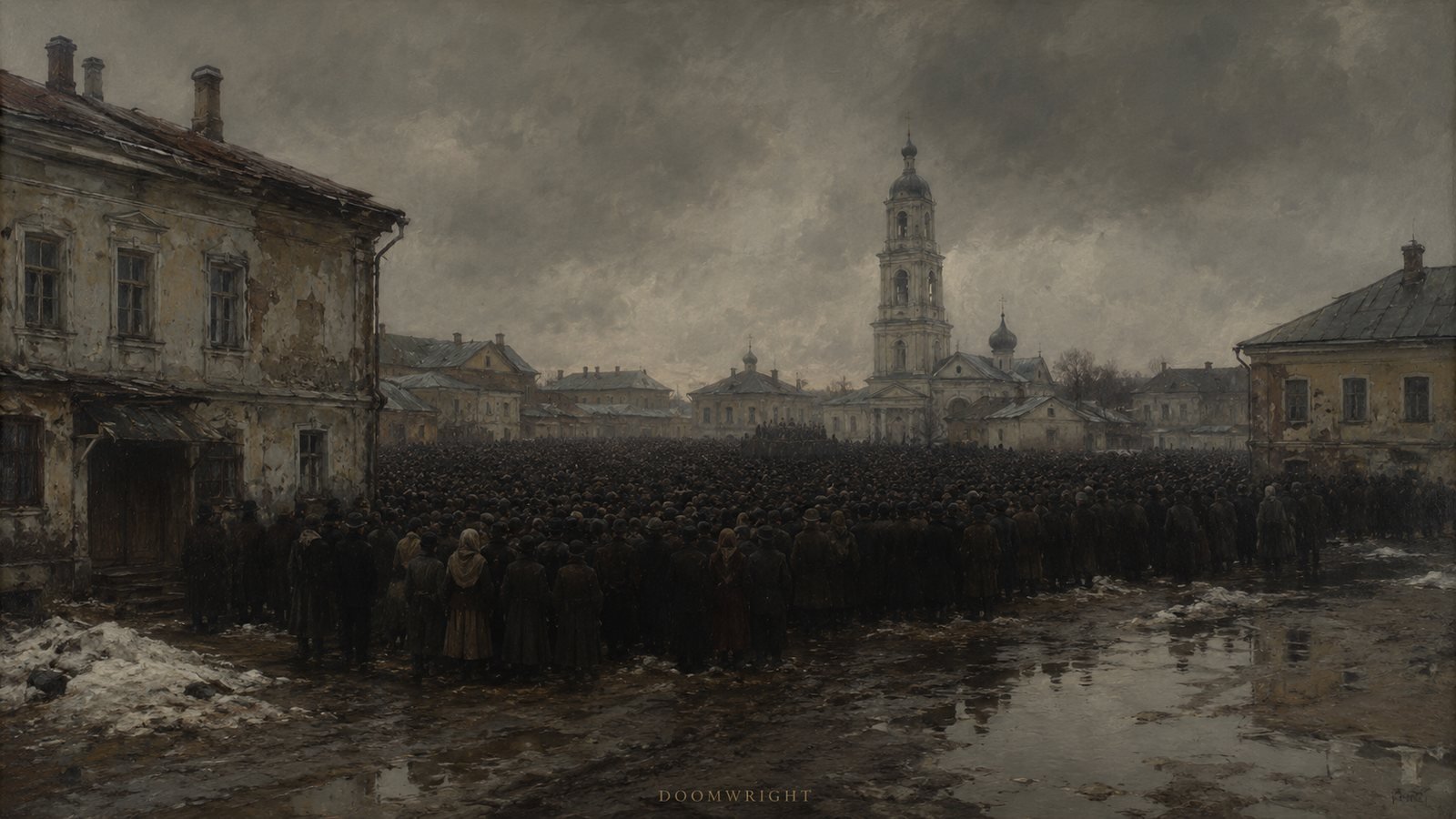
The Possessed No Longer Need to Believe
One line in “One Mouth” may be the coldest in the album:
It does not need us to believe.
That is the point at which an idea becomes a system.
Early on, belief matters.
Arguments matter.
Conviction matters.
Later, behaviour continues through momentum, fear, loyalty, guilt and imitation.
People can even stop believing while continuing to participate.
By then, whether the original claim was true may be almost irrelevant.
The current moves because enough people are already inside it.
The Town Becomes the Final Body
Track VII is “The Run.”
Up to this point, possession has moved through individuals and small groups.
Now it becomes environmental.
The houses burn.
People drown.
People hang themselves.
The streets become chaotic.
The entire town behaves like one organism convulsing.
That is why the album shifts into overlapping voices rather than a single narrator.
No one owns the scene anymore.
The song says:
The thing that started in one sleeper
Now running screaming through the land.
The Idea that once needed a beautiful voice has become fire, movement and panic.
There is no sermon left.
Only consequences.
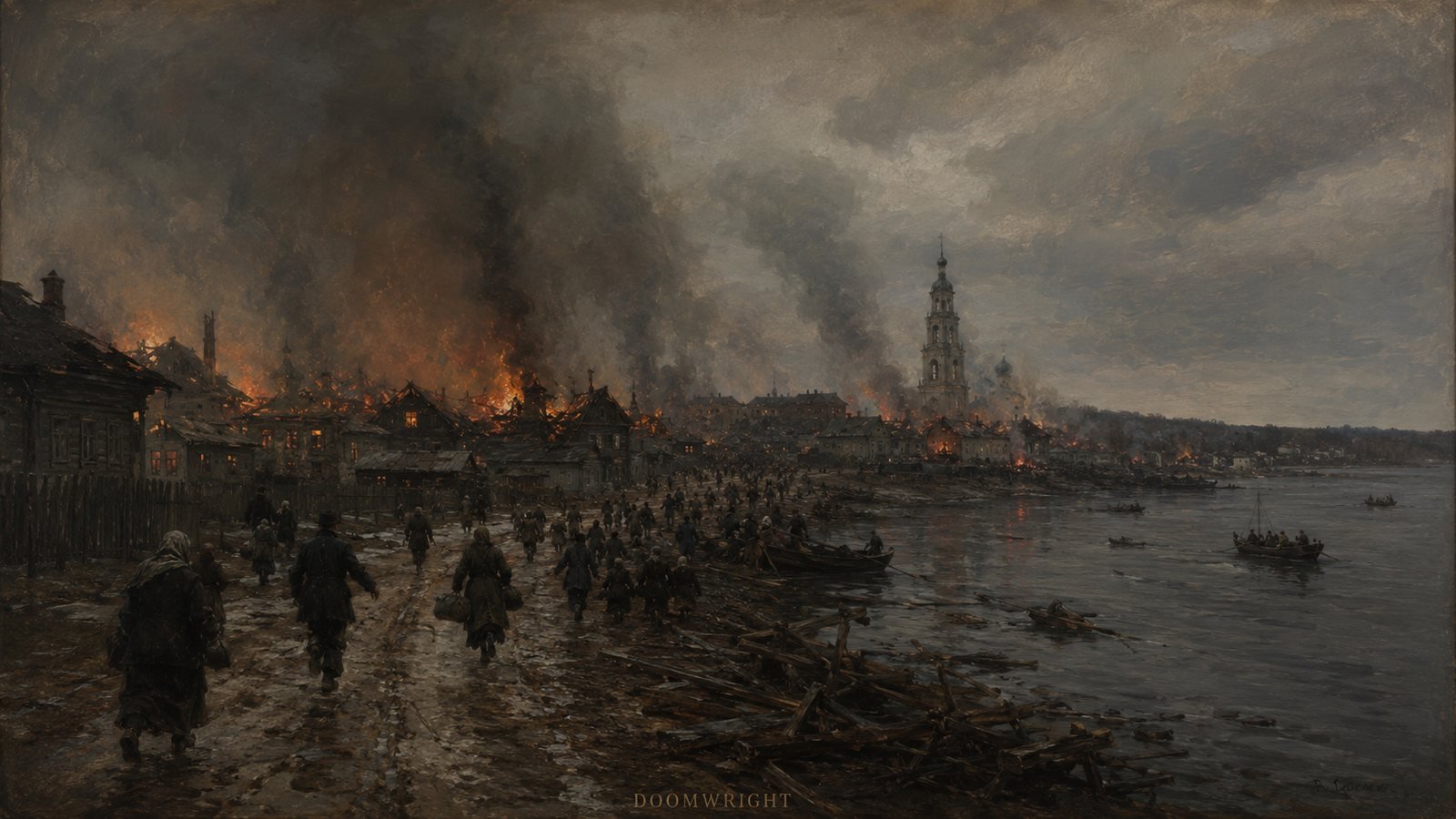
Then Everything Cuts to Silence
“The Run” does not resolve.
It stops.
Suddenly.
That cut matters because the final track must feel like waking after collective delirium.
No triumphant conclusion.
No victorious counterargument.
No grand moral speech.
Only aftermath.
Black Water
The final movement is “Black Water.”
The town has gone down.
The bells are nearly still.
The cold water remains.
And for the first time since the collective took over, one individual human voice returns.
The album master calls this the return of the lone I.
He says:
I stood among the birches, watching.
That pronoun matters because the album has spent several tracks destroying it.
I.
Each.
We.
One mouth.
A hundred voices.
Then finally:
I.
The survivor is not presented as heroic.
He is simply separate.
Sane enough to remain on the bank.
Alive enough to witness.
Damaged enough that he cannot explain what happened.
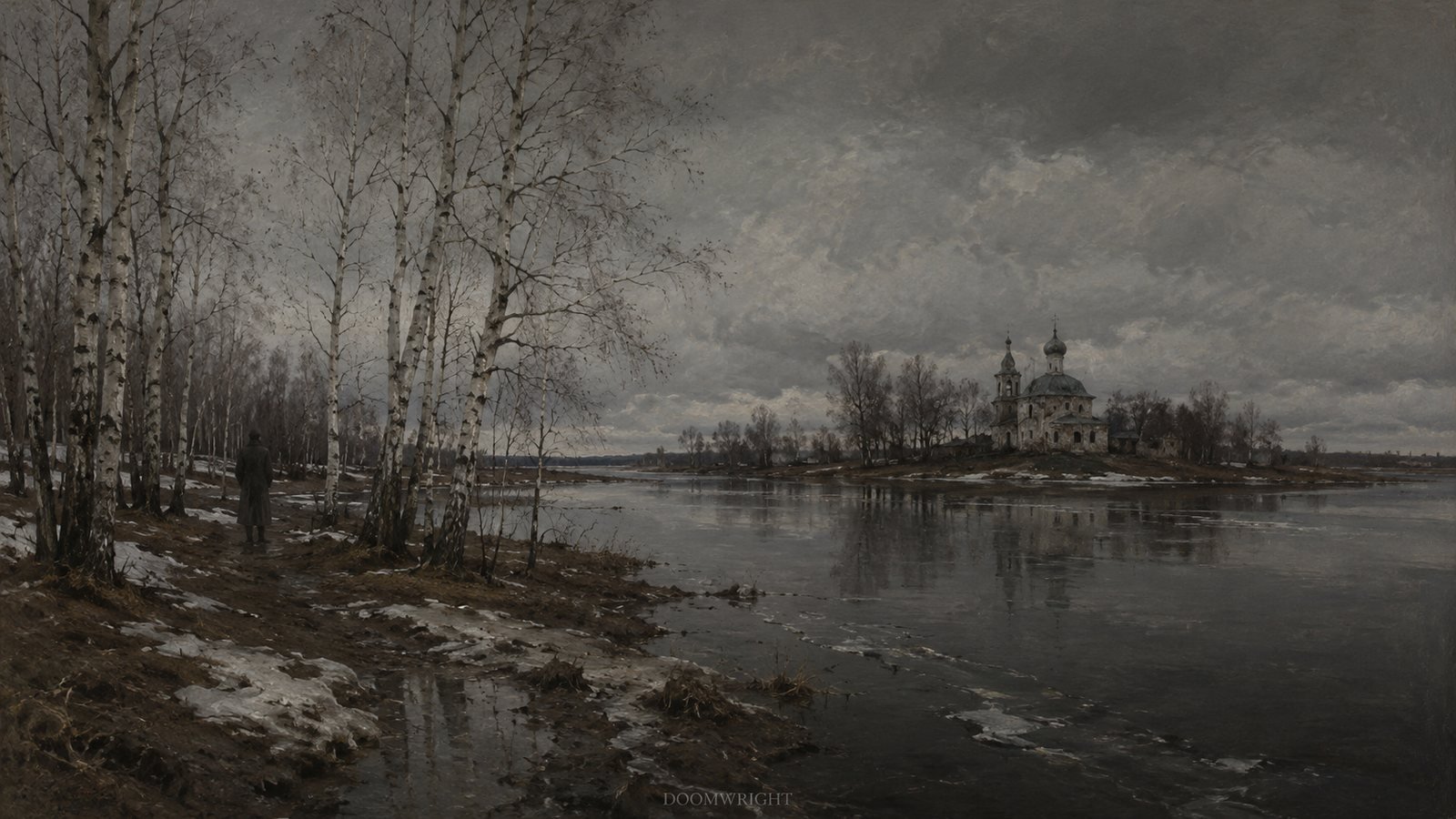
The Fever Never Had a Body
And then comes the final problem.
The town is destroyed.
The possessed are dead.
But what about the thing that possessed them?
The closing song says:
The fever never had a body
And so the fever did not drown.
That is the ending I wanted.
If the album ended by killing the Idea, it would become comforting.
The listener could imagine that the danger belonged to these people, in this town, at this moment.
But an idea has no corpse.
It cannot be pulled from the water.
It cannot be buried.
It can simply appear somewhere else.
The final image is therefore not victory.
It is transmission interrupted.
For now.
Why the Album Sounds Russian Without Becoming Folk Metal
The atmosphere of THE POSSESSED is as important as the plot.
I wanted nineteenth-century provincial Russia to be felt as environment rather than reproduced as musical cliché.
So there are no obligatory folk instruments.
No theatrical “Russian” melodies.
No decorative balalaika.
Instead:
distant church bells,
thawing snow,
mud,
candle smoke,
empty drawing rooms,
birch trees,
frozen rivers,
black water.
The master sheet explicitly defines the Russian atmosphere as texture, not folk.
That choice supports the central metaphor.
The town should feel spiritually cold before it becomes violent.
The destruction grows out of exhaustion.
Not spectacle.
Three Arcs Carry the Entire Record
Underneath the eight tracks, the album is really built from three simultaneous transformations.
The music moves from cold atmosphere, through seduction, into murder and collective violence, then collapses into funeral stillness.
The clean baritone appears only while the Idea is persuading people, delivers the final command in Track V, then vanishes.
And the language itself moves from individual identity toward collective identity before one solitary I returns at the end.
Those three arcs are the album's structural core.
That is why THE POSSESSED is not simply eight songs describing scenes from Demons.
The record itself becomes possessed.
Its voices change.
Its pronouns change.
Its atmosphere closes in.
And eventually the thing that seemed to be leading the story disappears inside the people who followed it.
The Demon Is the Empty Place
Dostoevsky's title invites a supernatural metaphor.
Who are the demons?
Who is possessed?
The novel offers much more than one simple answer.
For THE POSSESSED, I chose to make the metaphor literal in sound but not supernatural in plot.
The demon is not a horned figure.
It is the empty place an idea can occupy when people surrender authorship of themselves.
That is why the Idea says:
I do not need you to believe me.
I only need to outlast you.
And that is why it disappears before the album ends.
Once the Idea has entered enough people, its original voice becomes unnecessary.
The possessed speak for it.
Hear THE POSSESSED
THE POSSESSED is an eight-movement DOOMWRIGHT album after Fyodor Dostoevsky's Demons.
It begins with a provincial Russian town in the thaw.
An Idea finds a voice.
A closed room turns individuals into a collective.
A hollow man becomes a mirror for other people's convictions.
Someone tries to leave.
The group murders him.
And at that exact point, the voice of the Idea disappears from the record.
What remains is the herd.
Then the run.
Then black water.
Then one human voice standing among the birches.
The album combines cold Russian atmospheric and depressive black metal with blackened death-doom, using bells, thaw, snow, candle smoke, birch and water to create the feeling of a province gradually losing its soul rather than a conventional battlefield.
The final horror is not that the fever kills the town.
It is that the fever survives it.
The fever never had a body.
And so the fever did not drown.
DOOMWRIGHT — THE POSSESSED